The Modelithics COMPLETE Library™ was introduced to the industry in 2003 with models that represented a little more than 1,500 active and passive devices from about a dozen vendors. In the years since its introduction, the library has experienced extensive growth in terms of its number of models. As of early 2024, the Modelithics COMPLETE Library represents more than 27,000 components from over 70 vendors. New library versions are constantly being released to provide designers with new models. In addition to new models, new library versions typically include updated versions that expand the capabilities of existing library models. These enhanced models, known as “Microwave Supermodels,” are the focus of this application note.
Definition of a Microwave Supermodel
Modelithics often updates an existing model to enhance its range of coverage in terms of frequency, substrates, or other parameters. The updated model then becomes what is known as a Microwave Supermodel™. A Microwave Supermodel is defined as a Modelithics model that has been enhanced from a previous model version to offer a wider range of coverage in terms of frequency validation, part values, substrate scalability, bias, or temperature. By containing a superset of previous and enhanced capabilities, a Microwave Supermodel has the benefit of offering a more complete scalability range in comparison to the previous model version. Microwave Supermodels support the widest range of application space and make it easier than ever for designers to increase productivity and accelerate design success.
Microwave Supermodel Example
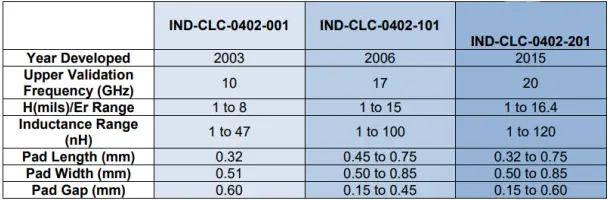
To illustrate the concept behind a Microwave Supermodel, let’s look at the Microwave Global Model™ for the Coilcraft 0402CS series of surface-mount chip inductors. This model was originally developed in 2003 as model number IND-CLC-0402-001. The original model was validated to 10 GHz and covered a part-value (inductance) range of 1 to 47 nH. It was also validated for substrates with H/Er (substrate height divided by dielectric constant) ratios ranging from 1 to 8. Lastly, the model did not offer solder-pad scalability.
The IND-CLC-0402-001 model was later updated in 2006. The updated version (model number IND-CLC-0402-101) extended the maximum validated frequency to 17 GHz and the part-value range to 1 to 100 nH. On top of that, the substrate validation range (H/Er) was extended to 1 to 15. Finally, the updated model also implemented solder-pad scalability.
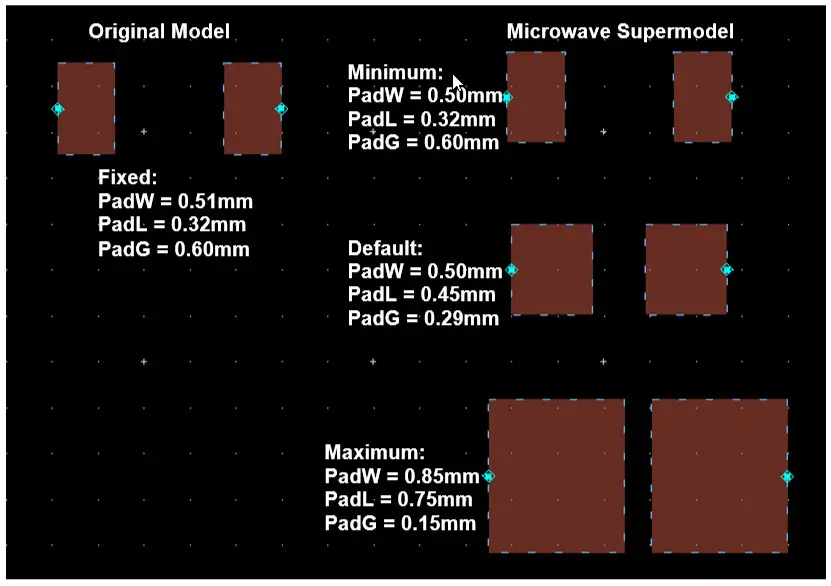
Note that the IND-CLC-0402-001 and IND-CLC-0402-101 models were developed separately with different sets of substrates for validation measurements. The solder-pad dimensions represent the biggest difference between the two models, as the pad dimensions of the original model are outside the pad scaling range of the updated model. Having said that, Modelithics later created a third model iteration, which is the currently available IND-CLC-0402-201 Microwave Supermodel. This Microwave Supermodel covers a range of pad dimensions that encompasses the validated pad dimensions of the first two model iterations.
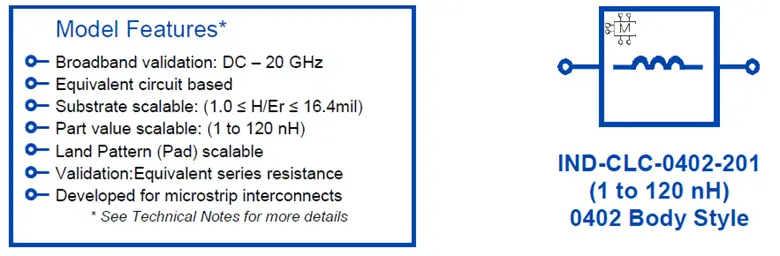
In addition, at the time the IND-CLC-0402-201 model was being developed, it was learned that additional part values were made available for the 0402CS inductor series. Hence, Modelithics completed additional measurements to extend the inductance range of the model to 120 nH. Table 1 compares the validation ranges of all three model versions. Note that the frequency, substrate, and pad dimension ranges were all expanded in the third version of the model. The model information datasheets, which are available for all Modelithics models, also provide a summary of the model features and validation ranges (Fig. 1).
Table 1. Comparison of the validation ranges for all three iterations of the model for the Coilcraft 0402CS series.
Figure 1. Details of the IND-CLC-0402-201 Microwave Supermodel taken from the model datasheet.
Keep in mind that when a Microwave Supermodel is released, the replaced older model versions are removed from the simulator palette or part selector. However, to maintain compatibility with older schematics, the replaced model versions are still contained in the library (in hidden palettes) and can still be simulated.
Supermodel Performance
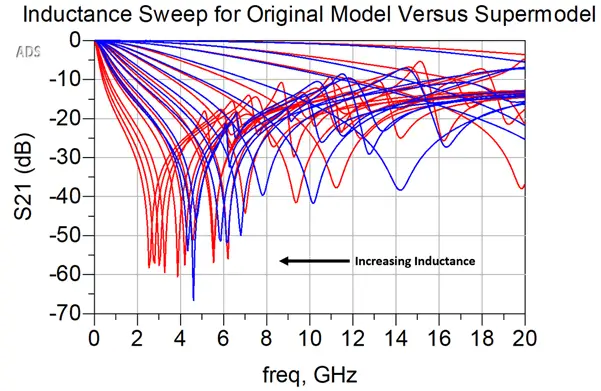
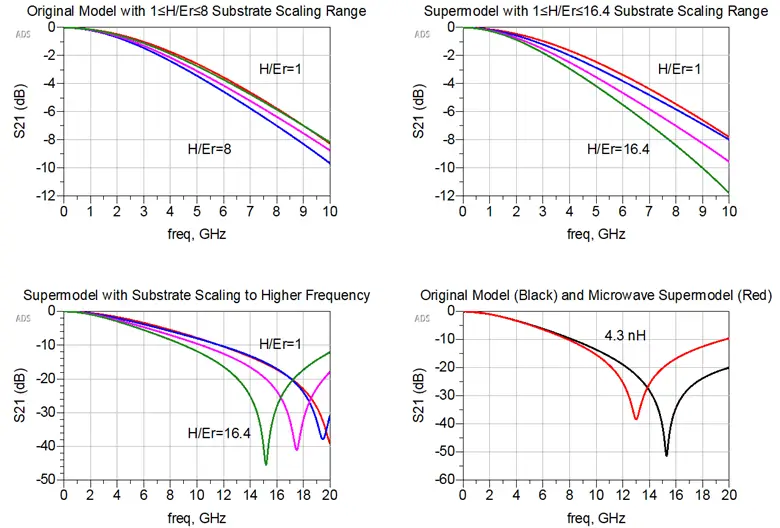
The advantages of a Microwave Supermodel include maximal dimensional scalability ranges and higher validation frequencies. To illustrate, let’s see the IND-CLC-0402-201 Microwave Supermodel in action. Figures 2, 3, and 4 show how this model is more useful and flexible compared to the previous model iterations.
As a side note, in Figure 2, we see how the original model is only validated with measurements up to 10 GHz. However, the model continues to simulate in a physically reasonable manner beyond the upper validation frequency. This aspect represents a significant advantage that Microwave Global Models have over conventional S-Parameter file-based models.
Figure 2. Part-value (inductance) sweeps for the original IND-CLC-0402-001 model (1 to 47 nH) and IND-CLC-0402-201 Microwave Supermodel (1 to 120 nH) shown by the blue and red traces, respectively.
Figure 3. Comparison of pad-dimension limits for the original IND-CLC-0402-001 model (left) and IND-CLC-0402-201 Microwave Supermodel (right). Shown on the right are the minimum (top), default (middle), and maximum (bottom) pad sizes of the IND-CLC-0402-201 Microwave Supermodel.
Figure 4. Comparison of substrate sweeps for the original IND-CLC-0402-001 model (top left) and IND-CLC-0402-201 Microwave Supermodel (top right) for a 3.3-nH 0402CS inductor. Shown on the bottom left is the substrate sweep of the Microwave Supermodel extended to a higher frequency. Shown on the bottom right is a comparison of the original model and Microwave Supermodel.
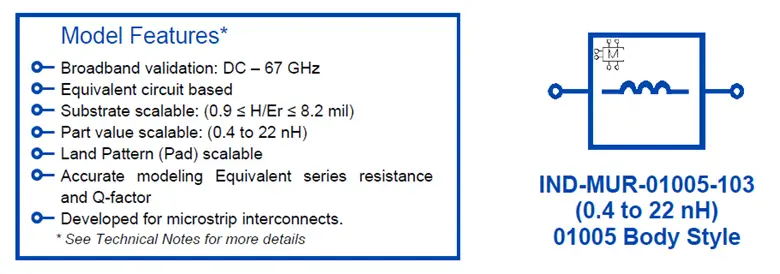
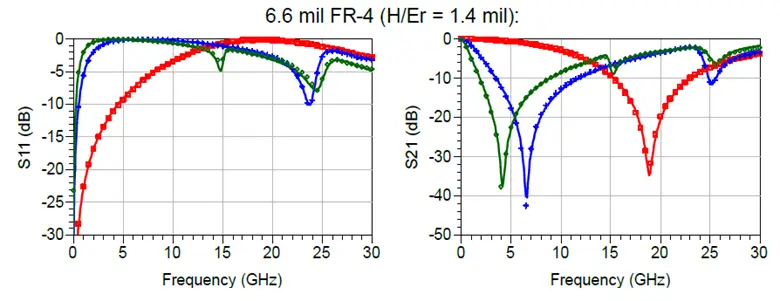
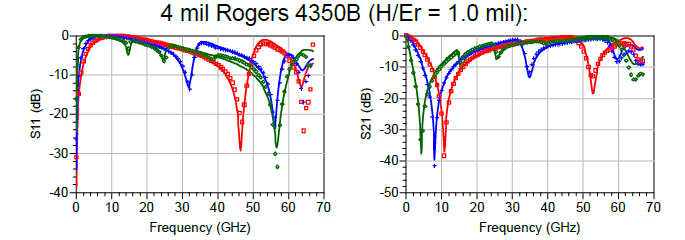
Another Microwave Supermodel is the IND-MUR-01005-103 model for the Murata LQP02TQ inductor series. This Microwave Supermodel extends the upper validated frequency range to 67 GHz (the original IND-MUR-01005-003 model was only validated to 30 GHz). Figure 5 shows the model features taken from the model information datasheet. Figure 6 shows the S-Parameter results for the original IND-MUR-01005-003 model, while Figure 7 shows the same for the IND-MUR-01005-103 Microwave Supermodel.
Figure 5. Details of the IND-MUR-01005-103 Microwave Supermodel taken from the model datasheet.
Figure 6. Modeled (solid lines) and measured (symbols) S-Parameter results for the IND-MUR-01005-003 model for the Murata LQP02TQ inductor. Red: 1.2 nH; Blue: 10 nH; Green: 22 nH. The substrate is 6.6-mil FR-4.
Figure 7. Modeled (solid lines) and measured (symbols) S-Parameter results for the IND-MUR-01005-103 Microwave Supermodel for the Murata LQP02TQ inductor. Red: 3.9 nH; Blue: 6.8 nH; Green: 22 nH. The substrate is 4-mil Rogers 4350B.
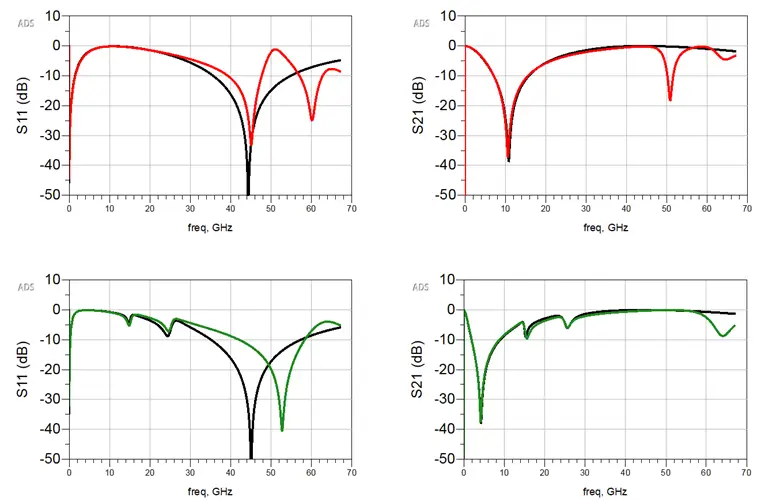
Figure 8 compares the simulated S-Parameters of the original IND-MUR-01005-003 model and IND-MUR-01005-103 Microwave Supermodel. Shown are comparisons for inductance values of 3.9 and 22 nH. As expected, the analysis reveals a large discrepancy between the models above 30 GHz, which is the maximum validated frequency of the original model.
Figure 8. Simulated S-Parameter results for the original IND-MUR-01005-003 model (black traces) and IND-MUR-01005-103 Microwave Supermodel (red and green traces). The top two graphs represent an inductance of 3.9 nH, while the bottom two graphs represent an inductance of 22 nH. The substrate is 6.6-mil Rogers 4350B.
About this note: This application note was originally developed by Isabella Bedford (formerly with Modelithics), Hetvi Patel, and Laura Levesque (formerly with Modelithics) with updates made in 2024 by Chris DeMartino and Larry Dunleavy.
Contact Information: For information about Modelithics’ products and services, please contact us at:
Address: Modelithics, Inc. 3802 Spectrum Blvd., Suite 130 Tampa, FL 33612 Voice: 813-866-6335 Email: sales@modelithics.com Web: www.modelithics.com